The Bilingual Advantage: How Early Multi-Language Exposure Shapes Young Brains
Discover how early multi-language exposure shapes young brains and sets your child up for lifelong success. This post explores the incredible cognitive benefits of bilingual infant care, from enhanced executive function and superior problem-solving to improved memory retention.
October 27, 2026

Parents often wonder, how does early multi-language exposure shape young brains? Research shows that introducing multiple languages during infancy doesn't just teach vocabulary, it fundamentally wires the brain for advanced cognitive flexibility, executive functioning, and problem-solving.
Quick Answer: The Core Cognitive Benefits of Early Bilingualism:
- Enhanced Executive Function: Switching between languages strengthens the brain's command center for focus, self-regulation, and multitasking.
- Superior Problem-Solving: Dual-language learners are constantly deciphering linguistic patterns, sharpening their analytical skills.
- Improved Memory Retention: Storing separate vocabulary structures fortifies short-term and working memory.
- Cultural Empathy & Social Awareness: Early language exposure naturally builds stronger interpersonal skills and open-minded perspective-taking.
From the moment they are born, infants are linguistic sponges. At birth, a child has the remarkable ability to distinguish between all 800 phonetic sounds that make up human language. However, by the time they reach 9 months old, a natural process called 'synaptic pruning' begins. The brain starts shedding the neural pathways for sounds it does not hear daily. This is why introducing a second language, or maintaining a multilingual environment, as early as possible provides an unparalleled developmental advantage.
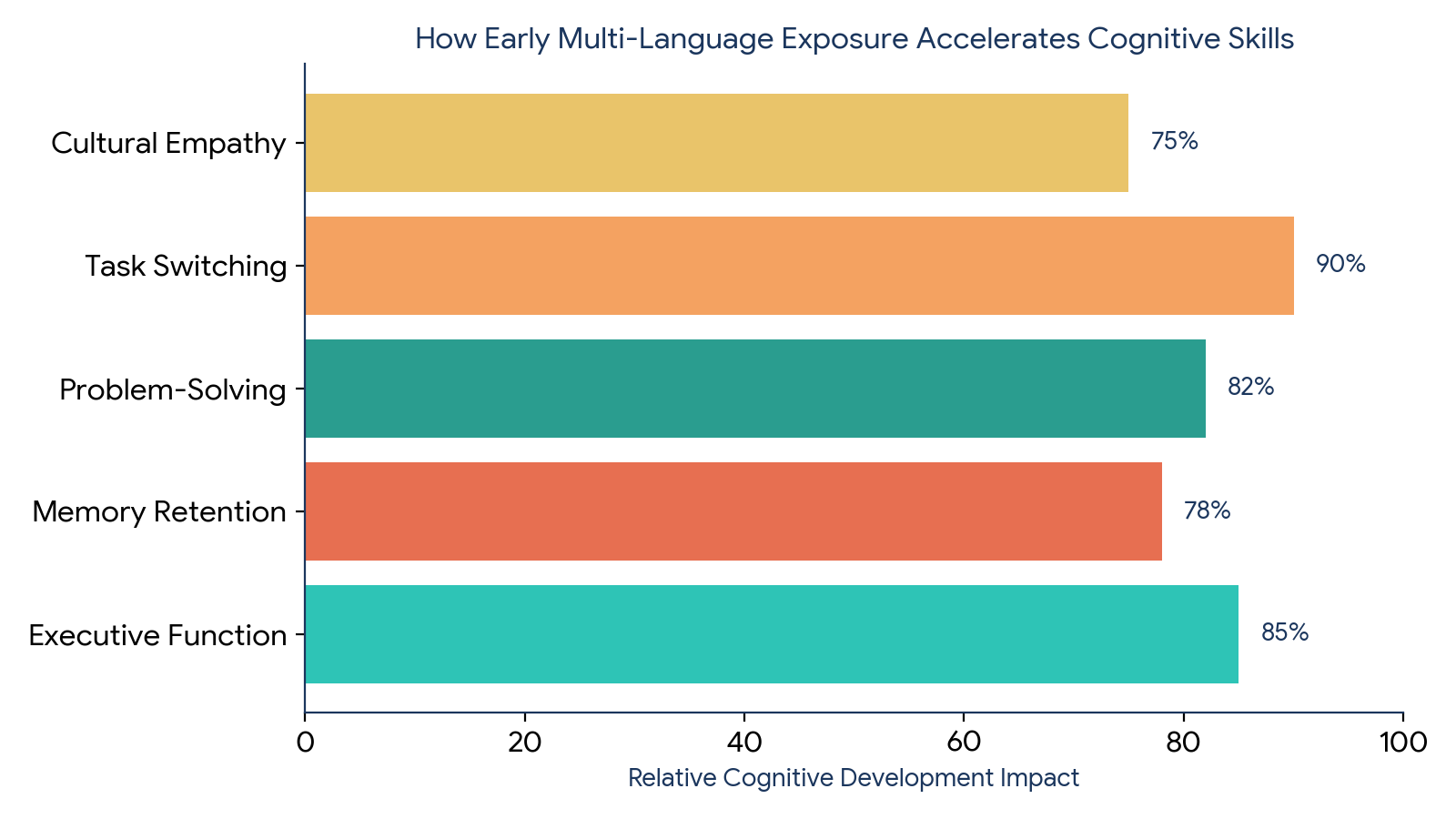
How Does Bilingualism Improve a Toddler's Executive Function?
Executive function is the brain's management system, responsible for planning, paying attention, and switching focus. When a child learns in a bilingual or multilingual environment, their brain is constantly doing a heavy mental workout. It has to decide which language system to use and suppress the urge to use the other. This mental juggling act acts like a gym session for the frontal lobe, resulting in children who excel at filtering out distractions and adapting to new learning tasks.
How Can Parents Introduce Multiple Languages at Home?
You do not need to be perfectly fluent in multiple languages to provide your child with the benefits of early exposure. Consistency and natural integration are key.
What Should Parents Focus On for Infants?
For infants, the focus is entirely on sound exposure and authentic interaction. Play songs, read bilingual books, and narrate daily routines in different languages. Screen time does not build language pathways; the infant brain requires face-to-face human interaction to register and map linguistic sounds.
What Should Parents Focus On for Toddlers?
As your child enters the toddler phase, contextualize the languages. Use one language during designated play hours or meal times, or have each parent consistently speak their native language. This helps the toddler categorize linguistic structures smoothly without confusion.
What If You Only Speak One Language at Home?
You do not need to be bilingual yourself to give your child the cognitive benefits of multi-language exposure. In fact, millions of children raised by monolingual parents become fluent dual-language speakers simply through early immersion.
When parents only speak English at home, early childhood care is where the foundation is built. Here is how monolingual parents can easily support their child's language journey without stress:
- Let Native Educators Do the Heavy Lifting: Young brains learn language through authentic human connection, not grammar drills. Enrolling your child in an immersive early education program where native-speaking educators integrate languages like Spanish or Ukrainian into daily songs, storytime, and play gives your child native phonetic mapping that you don't have to teach yourself.
- Let Your Child Be the "Teacher": When your child comes home with new words, ask them to teach you! Having your toddler "explain" what a word or song means in English empowers them, reinforces their memory, and creates a fun, low-pressure bonding experience.
- Provide Passive Auditory Exposure: You don't need to speak the language to play it. Turn on children's songs, nursery rhymes, or audiobooks in the target language during car rides or morning routines. Even if you don't understand every word, your child's brain is actively mapping the rhythm, cadence, and phonetic structures.
- Normalize "Learning Together": Read bilingual picture books where the English text is side-by-side with Spanish or Ukrainian. Learning a few basic greeting words alongside your toddler models curiosity and shows them that exploring new cultures is exciting.
What Are the Common Myths About Early Multilingual Education?
The most persistent myth is that teaching a baby multiple languages causes speech delays. Scientific research confirms this is entirely false. While a bilingual child might occasionally combine words from different languages into a single sentence (known as code-switching), their total conceptual vocabulary across both languages is equal to or larger than that of a monolingual child. Multilingual exposure expands brain capacity rather than overwhelming it.
How iLearn Center Supports Multilingual Cognitive Development Across Chicago?
Finding an early childhood center that actively fosters this crucial window of brain neuroplasticity can be challenging in Chicago. Unlike massive corporate franchises that treat language as an occasional elective, iLearn Center was built on an immersive Intelligent Learning framework.
We offer rich bilingual infant care in Chicago where our educators naturally integrate English, Ukrainian, and Spanish into daily activities. Our built-in language immersion framework is fully integrated into the standard curriculum at zero extra cost. Children participate in daily conversational circles, storytelling, and songs, learning through music, visual flashcards, and playful games without any pressure. Whether you utilize our daycare drop-off zone on Ashland Ave in Lincoln Park, commute from the West Loop to our Grand & Leavitt campus near West Loop, or seek childcare near Chicago Ave CTA in West Town, your child benefits from our dedicated multilingual early education programs. Our 80%+ educator retention rate ensures your child builds deep, trusting bonds with tenured, native-speaking teachers every morning.
FAQ's About Early Multilingualism:
Will my child get confused if we speak multiple languages at home?
No. A child's brain is naturally built for language acquisition. While they may occasionally borrow words across languages as their vocabulary develops, they naturally organize and separate the languages by speaker and environment as they grow.
When is the best time to start bilingual infant care?
The optimal window for language learning is from birth to age three. During this period of peak neuroplasticity, young brains absorb phonetic sounds effortlessly without the conscious study required in later childhood.
How Can You Schedule a Tour to Explore iLearn Center?
Ready to give your child the lifelong cognitive advantages of early language immersion? Schedule an in-person daycare tour at your nearest iLearn Center location today to see our immersive multilingual classrooms in action!
Get in Touch & Schedule
Your Visit

Chicago, IL 60614Tel: 773-360-7702Email: anastasiia@ilearncenter.com
7:00 AM – 6:30 PM
Chicago, IL 60622Tel: 312-888-9983Email: olha@ilearncenter.com
6:30 AM – 6:30 PM
Chicago, IL 60612Tel: 773-312-3570Email: Sandra@ilearncenter.com
6:30 AM – 6:30 PM