How Can Chicago Parents Ease Daycare Separation Anxiety During Morning Drop-Off?
Transitioning your child into daycare is an emotional milestone, but morning drop-off doesn’t have to be a daily struggle. Our latest guide breaks down the psychology behind early childhood separation anxiety and gives Chicago parents an actionable, 4-step morning drop-off routine.
October 21, 2026

To help your toddler adjust to daycare drop-off and quickly ease separation anxiety, implement this consistent routine:
The 4-Step Drop-Off Routine:
- Prepare the Night Before: Pack bags, meals, and comfort items to eliminate rushed morning stress.
- Talk Through the Commute: Frame the morning using clear milestones (e.g., "First circle time, then park play, and I will pick you up right after naptime").
- Keep Goodbyes Under 2 Minutes: Execute a brief, predictable goodbye ritual, hand your child directly to a trusted teacher, and never sneak out.
- Remain Calm and Consistent: Your child mirrors your emotional cues; exiting with a confident smile builds their trust in the environment.
Transitioning your child into daycare is one of the most emotional milestones in early parenthood. Whether you are dropping off a 12-week-old baby or walking a 2-year-old toddler through the doors, tears from both parent and child are completely natural. This comprehensive guide breaks down the science of early attachment, explains exactly how to ease daycare separation anxiety, and outlines a step-by-step morning routine tailored for busy Chicago families.
What Is Daycare Separation Anxiety, and Why Is It Normal in Early Childhood?
Separation anxiety is a natural, healthy developmental milestone indicating that your child has formed a secure, loving emotional attachment to you as their primary caregiver.
When a child cries during drop-off, their brain is experiencing a protective stress response. They are signaling that you are their safe person. The anxiety arises not because the daycare is unsafe, but because the child is learning object permanence and emotional regulation. Your child is figuring out how to feel secure when their primary attachment figure is out of sight.
Child development research shows separation anxiety typically peaks twice: first between 8 to 12 months when infants realize parents exist even when out of sight, and again between 18 to 24 months as toddlers assert independence while simultaneously craving emotional security.
How Can Chicago Families Build a Step-by-Step Morning Drop-Off Routine?
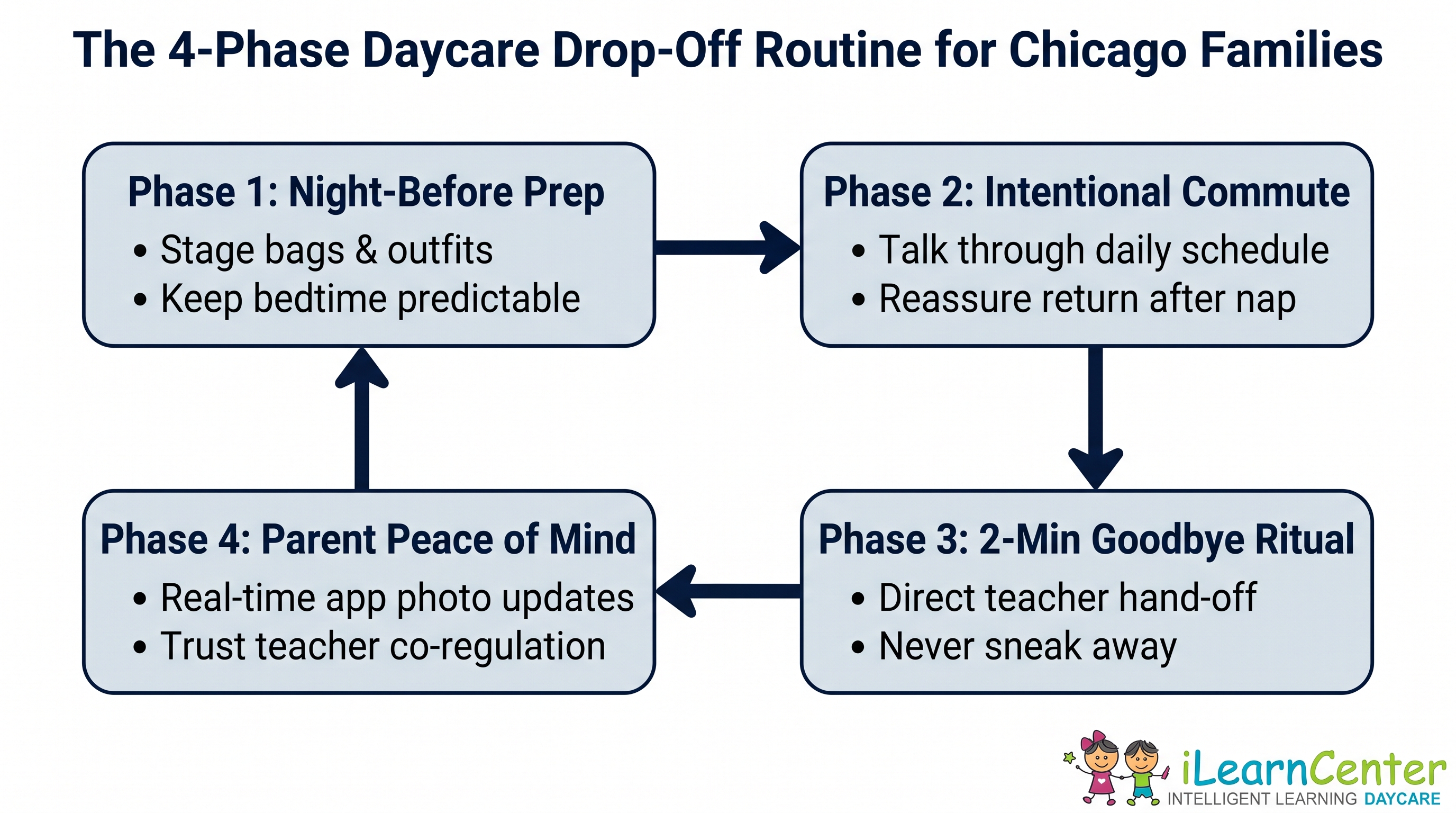
Building trust through consistency is the fastest way to alleviate drop-off distress. Following a structured four-phase routine (Night-Before Prep, Intentional Commute, 2-Minute Goodbye Ritual, and Parent Peace of Mind) turns morning uncertainty into a familiar, comforting pattern.
Rushed, chaotic mornings elevate cortisol levels in both parents and children, making the actual drop-off much harder. By moving logistical tasks to the evening and turning the commute into a positive transitional buffer, children arrive at the center feeling secure and prepared for their day.
A parent rushing to beat traffic on the Kennedy Expressway or scrambling to catch a CTA train near West Town adds subtle pressure that children absorb. Slowing down the sequence provides a calm bridge between home and school.
How Should Parents Prepare the Night Before to Eliminate Morning Stress?
Phase 1: Low-Stress Home Preparation
- Eliminate Morning Rush: Rush breeds cortisol. Pack diapers, extra outfits, and breastmilk or formula bottles the evening before to ensure your morning is focused on connection rather than logistics.
- Maintain Home Predictability: Serve breakfast at the same time every morning. At iLearn Center, organic daily breakfast, lunch, and snacks are provided, giving parents one less item to prep.
- Introduce a Transition Object: Allow your child to carry a familiar blanket, small stuffed animal, or family photo in their cubby.
How Can You Use the Chicago Commute to Prepare Your Child Mentally?
Phase 2: Intentional Commute Dialogue
- Name the Milestones: Whether driving along Ashland Ave or riding the Chicago Ave bus, talk through the day using concrete reference points. Toddlers do not understand "3:00 PM," but they understand "after naptime and afternoon snack."
- Use Reassuring Language: Say "I always come back after naptime," rather than "Don't cry." Validating their feelings while reassuring them of your return creates psychological safety.
What Does an Effective 2-Minute Goodbye Ritual Look Like at School Arrival?
Phase 3: The 2-Minute Quick Goodbye Ritual at Center Arrival?
- Utilize Dedicated Loading Zones: Pulling into a dedicated drop-off zone (such as outside our Lincoln Park daycare on Ashland Ave or West Town childcare center on Chicago Ave allows you to focus on your child rather than parking stress.
- Keep Goodbye Short and Sweet: Prolonged goodbyes heighten toddler anxiety. Create a specific 15-second goodbye ritual—a high-five, a butterfly kiss, and a consistent phrase like "I love you, have fun, and I'll see you after your nap!"
- Hand Off Directly to a Lead Teacher: Transfer physical contact or hand holding directly to your child's educator. Over 80% of iLearn's teaching staff have been with our centers for over 7 years, providing familiar, trusted arms for your child.
- Never Sneak Away: Sneaking out while a child is distracted breaks trust and increases anxiety during subsequent drop-offs. Always say goodbye, even if your child is crying.
How Can Parents Gain Peace of Mind After Drop-Off?
Phase 4: Post-Drop-Off Reassurance for Parents
- Check Real-Time App Updates: Most children stop crying within 2 to 3 minutes of parent departure once engaged in circle time or sensory play. Through our parent mobile communication app called Brightwheel, educators send quick photo updates so parents see their child smiling and settled.
What Age-Specific Strategies Ease Separation Anxiety for Infants vs. Toddlers?
Because cognitive development drastically changes between 6 weeks and 3 years, applying the right transition strategy for the child's specific developmental phase prevents unnecessary stress and fosters faster adjustment.
Easing the Infant Daycare Transition (6 Weeks to 18 Months)
For infants entering our infant and toddler programs, separation anxiety revolves around sensory unfamiliarity. To support this transition, replicate home feeding and nap routines as closely as possible. Provide your Lead Educator with your baby’s exact home nap and feeding timings. Scent-infused comfort is incredibly effective; try sleeping with your baby's crib sheet or blanket for one night before bringing it to daycare so it smells like home. Furthermore, if your home is bilingual, inform your teachers. iLearn’s educators provide multi-language comfort in English, Spanish, and Ukrainian, ensuring babies hear familiar soothing sounds.
Easing Toddler Separation Anxiety (18 Months to 3 Years)
Toddlers thrive on autonomy and narrative predictability. Roleplay drop-off at home over the weekend; practice "playing daycare" with stuffed animals where the teddy bear says goodbye to mom, plays with blocks, and reunites happily. Offer micro-choices to give your toddler control over small details to build confidence (e.g., "Do you want to wear your red coat or blue coat to school today?"). Reading daycare transition books, such as The Kissing Hand by Audrey Penn, also gives toddlers vocabulary for their feelings.
What Drop-Off Mistakes Should Chicago Parents Strive to Avoid?
Parents should avoid sneaking out unannounced, making false time promises, bribing their child with treats, and showing personal hesitation or tears in the classroom.
Even well-meaning routines can accidentally prolong drop-off stress. Children are highly attuned to their parents' emotional states; if a parent looks anxious or apologizes for leaving, the child assumes the daycare environment must be unsafe.
Saying "I'm so sorry I have to leave you" frames daycare negatively. Instead, use confident bridge language: "I love you, you are going to have so much fun with your friends, and I will see you after snack."
How iLearn Center Supports Smooth Transitions Across Chicago
Our centers in Lincoln Park, West Town, and Grand & Leavitt are built around creating warm, home-like environments that ease family transitions. With long-tenured educators, strictly maintained low teacher-to-child ratios, and real-time photo logs, parents have peace of mind. Unlike large corporate centers that suffer from high staff turnover, over 80% of iLearn Centers lead educators have been with us for 7+ years. Seeing a familiar, trusted face every single morning is the fastest way to cure a toddler's drop-off anxiety. Enriched daily schedules featuring morning WeeGroove music, kids' yoga, sensory art, and organic breakfast quickly redirect toddler attention toward play and exploration. Plus, our convenient neighborhood access near major commuter routes on Ashland Ave, Chicago Ave, and Grand Ave near West Loop makes drop-off seamless for working parents.
What Are the Most Frequently Asked Questions About Daycare Separation Anxiety?
Addressing these common anxieties directly helps parents manage their own expectations and partner more effectively with their childcare educators.
How long does daycare separation anxiety typically last?
Most infants and toddlers adjust to a new daycare routine within 1 to 3 weeks. Consistent daily attendance, short goodbye rituals, and strong educator collaboration significantly shorten this adjustment period.
What should I do if my child cries uncontrollably at drop-off?
Hand your child directly to their lead teacher, complete your brief goodbye phrase, and walk out confidently. Educators are trained in comforting strategies, sensory redirection, and song. You can message the center director via our mobile app 10 minutes later for a photo update.
Should I pick up my child early during their first week of daycare?
Yes! If your schedule permits, a gradual intake schedule (e.g., half-days for the first 2 to 3 days) helps young children build confidence before transitioning to full-day enrollment.
How Can You Schedule a Tour to Explore iLearn Center’s Supportive Classrooms?
You can explore our supportive environments and meet our long-tenured educators by booking a personalized visit to our Lincoln Park, West Town, or Grand & Leavitt campuses.
We view early childhood education as a partnership between families and educators. Finding the right fit starts with walking through our doors and seeing our Intelligent Learning Curriculum in action.
Ready for a warm, supportive daycare transition? Schedule an in-person daycare tour at your nearest iLearn Center location today!
Get in Touch & Schedule
Your Visit

Chicago, IL 60614Tel: 773-360-7702Email: anastasiia@ilearncenter.com
7:00 AM – 6:30 PM
Chicago, IL 60622Tel: 312-888-9983Email: olha@ilearncenter.com
6:30 AM – 6:30 PM
Chicago, IL 60612Tel: 773-312-3570Email: Sandra@ilearncenter.com
6:30 AM – 6:30 PM